This post summarizes public reports and announcements for general education. Survey figures describe the people who responded, not every business. Check the linked sources before acting on any number.
Many businesses spent the last ten years getting their data ready for dashboards. Two research reports published at the end of October 2026 argue that this is not the same as being ready for AI. Here is what each report says, based on the summaries the publishers made public, and how I would apply it at a company without a data team.
Forrester: analytics-ready does not mean AI-ready
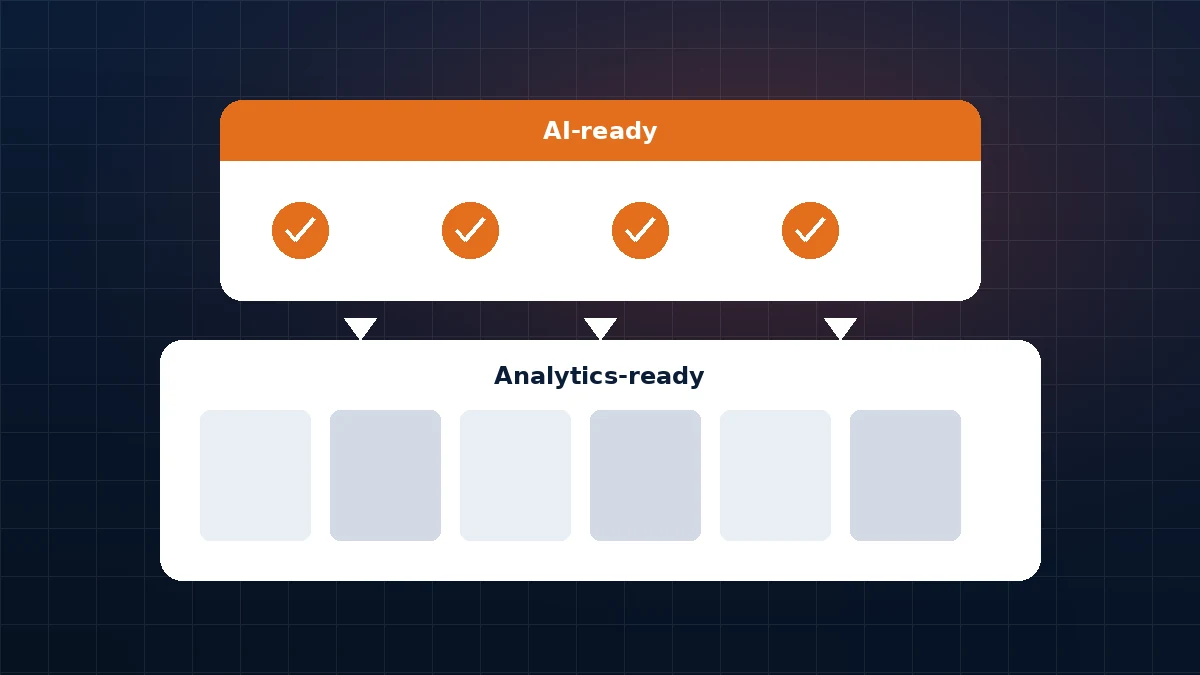
Forrester’s report AI Is Raising The Bar: Can Your Data Platform Keep Up?, published October 26, 2026, states the problem directly: “Being analytics-ready does not mean being AI-ready.” According to the summary, AI adds new demands for real-time data, business context, intelligent and integrated access, scalability and embedded governance. The report introduces a six-dimension assessment for measuring readiness and prioritizing investment.
Gartner: better models do not mean better agentic analytics
Gartner’s research note Scale Agentic Analytics With Lessons From Alibaba Cloud, Anthropic and OpenAI, published October 27, 2026, looks at how those three AI labs run their own internal data and analytics. Its summary says that stronger AI models did not translate into better agentic analytics. The labs relied on semantic controls, evaluation, access governance and human accountability. Gartner’s advice is to expand agentic analytics domain by domain, not in step with each new model release.
I find this the most useful point of the two reports. If the companies building the models still depend on definitions, testing and access rules, a 40-person distributor will too.
What AI-ready data looks like at a small company
Neither report is written for small businesses, but the ideas scale down. Here is how I translate the main ones:
- Business context. Document what each field means. “Ship date” should mean the same thing in the ERP, the spreadsheet and the AI tool.
- Semantic controls. Define your key metrics once, in one place, and have reports and AI tools use that definition.
- Integrated access. Connect the systems that matter, usually accounting, sales and inventory, into one database instead of emailing exports.
- Access governance. Decide who and what can read each table. An AI assistant should not see payroll because it was in the same folder.
- Evaluation. Keep a short list of questions with known answers and rerun them whenever a tool, prompt or data source changes.
- Human accountability. Name a person who owns each AI-assisted report and signs off before it is used.
None of this requires new software. Most of it can be done in the database and spreadsheets a business already has, as long as someone owns the work and writes the decisions down.
Where to start
Following Gartner’s domain-by-domain advice, I would pick one area where the data is already fairly clean, such as sales by customer or inventory by item. Fix the definitions, connect the sources, set access rules and test an AI assistant on that one area. Then move to the next domain.
For inventory in particular, my guides on inventory turns and days on hand and demand forecasting basics show which fields and definitions matter most.
Practical takeaway
If your dashboards work but the data behind them needs a person to explain it, it is not ready for AI yet. The fix is mostly unglamorous work: definitions, connections, permissions and tests. My database consulting for Boston and New England businesses covers setting up that foundation, my data analytics consulting page covers reporting on top of it, and my AI consulting services in Boston page covers adding AI once the data is ready. See all services, or Get a Quote at contact@peterklausz.com.
Additional sources
- InfoQ: AI, ML and Data Engineering Trends Report 2026 (October 30, 2026)
- HFS Research and DPW: AI is ready. Procurement is not. (October 16, 2026), which found that only 4% of the 150 procurement executives surveyed have unified, trusted, AI-ready data.
Peter Klausz is an MBA (University of Rochester, Simon Business School) and the founder of Statadventure, LLC, which has built supply chain software in Python and SQL since 2018. He previously managed F100 engine supply chain work at Pratt & Whitney. Based in Burlington, Massachusetts, he works with businesses across Boston and New England. Get a Quote.