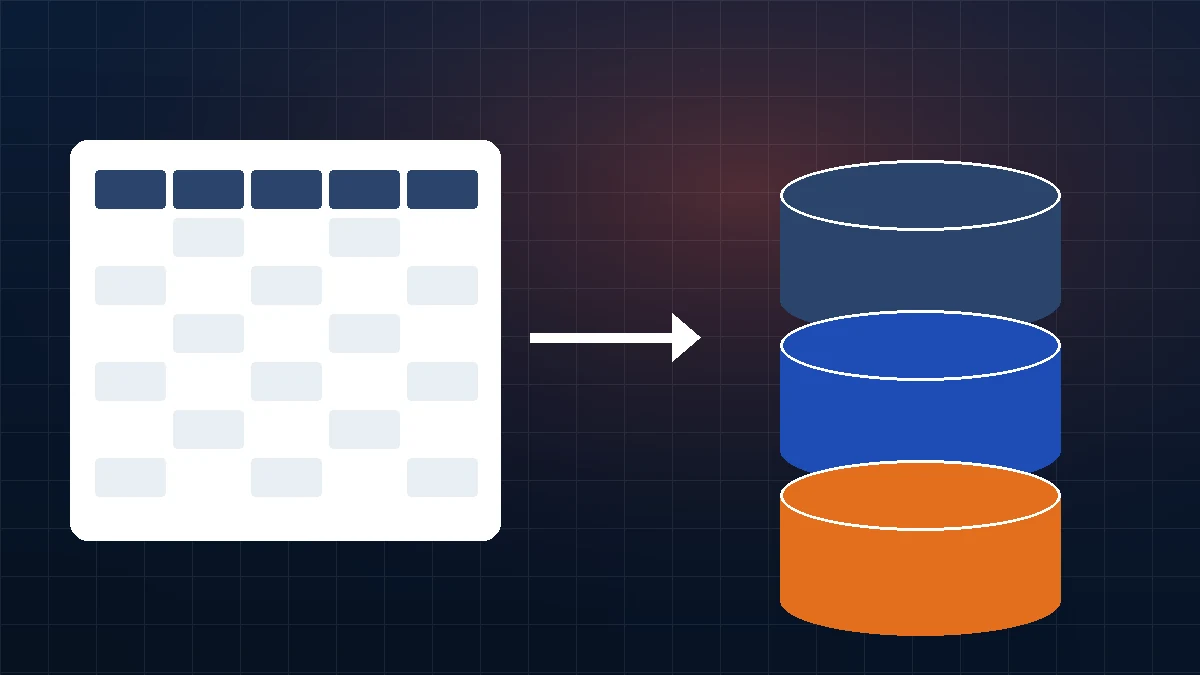
A spreadsheet-to-database migration should preserve the meaning of the records, not merely copy rows into new tables. I would settle identifiers, relationships, validation and reconciliation before scheduling the cutover. Otherwise, the business can end up with the same inconsistent information behind a more formal interface.
This guide concerns data migration. Turning a workflow into a web application is a separate decision; a useful database can support reporting or integrations without requiring a new custom front end.
Preserve a reference before cleaning
Save controlled, read-only copies of the original files and record which versions are in scope. Identify their owners and any formulas, linked workbooks or manual adjustments needed to interpret the values.
Do not clean directly in the only source copy. A correction log should explain what changed and why. When two files disagree, assign someone to decide which value is authoritative rather than letting import order determine the result.
Illustrative example: a supplier appears under an abbreviated name in one workbook and a legal name in another. A mapping may establish that both refer to one supplier. The names alone are not enough to prove it; the business needs supporting identifiers or an approved review.
Define entities and stable keys
List the entities the business needs to manage: customers, suppliers, products, orders or jobs. Give each a stable identifier and decide which natural business references must also remain available.
Define relationships explicitly. An order may have several lines, and a supplier may supply several products. A table should not depend on a user’s ability to recognize a name from another file.
PostgreSQL’s constraints documentation explains primary keys, unique constraints, not-null rules and foreign keys. These mechanisms can enforce agreed relationships and field requirements. They cannot decide which conflicting supplier or customer record is correct.
My database migration and design support can help translate those business rules into a structure the next system can use.
Specify transformations before the import
Write a mapping from each source column to the target field. Include data type, units, date interpretation, allowed values and handling of blanks. A blank can mean unknown, not applicable or not yet entered; those meanings should not be collapsed without review.
Keep a source identifier where practical so imported records can be traced back. Put rejected records into an exception report with reasons. Do not silently drop a row because it does not fit the new structure.
Run a trial import in a separate environment. Compare record counts, important totals, duplicate candidates and unmatched references. A successful technical load only means the database accepted the input, not that the migration preserved the business meaning.
Plan the cutover and recovery path
Decide when the old files stop being edited and how changes made during the transition are captured. If people continue editing both systems, the team needs an explicit reconciliation process rather than a hope that the versions will agree.
Define who can authorize the production import, who checks the results and what conditions would require a rollback. PostgreSQL’s backup and restore overview describes different recovery approaches; the implementation should fit the chosen environment and recovery needs.
Verify recovery in a safe test before relying on it. A backup plan that has never been exercised leaves an important question unanswered.
Accept the migration with evidence
Use an acceptance packet containing:
- The approved source file inventory and mappings.
- The identifier and relationship rules.
- Trial-import results and resolved exceptions.
- Reconciliation checks for counts and meaningful totals.
- Access permissions and ownership of ongoing corrections.
- The cutover, backup and rollback procedure.
- Instructions for the reports or applications using the database.
If the next step is reporting, business analytics consulting can connect the cleaned structure to defined measures. That work should not begin by assuming the migration solved every disagreement in the source material.
A good migration leaves a traceable record of what moved, what changed and what still needs attention.
Contact Us to plan a controlled move from shared spreadsheets to a database.