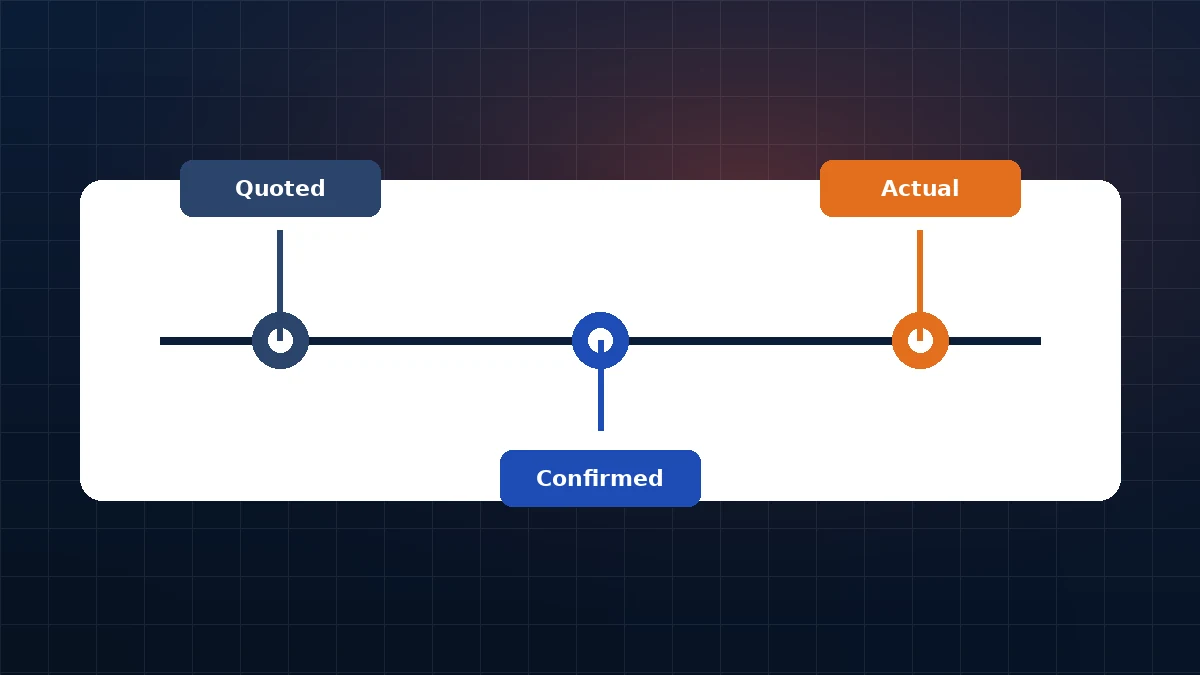
A supplier’s quoted lead time, its confirmed delivery commitment and the time an order actually takes are different pieces of information. I would preserve all three rather than overwrite one planning field whenever a date changes. That distinction helps explain delays and makes planning assumptions easier to review.
This guide is about collecting and interpreting purchase-order event data. It is not another safety-stock formula or demand-forecasting tutorial.
Define the start and end events
Choose what “lead time” means for the decision in front of you. Time from order release to supplier shipment answers a different question from time between order release and usable receipt. Inspection or receiving delays may matter to availability even when the supplier shipped as promised.
Record the event names and the system that provides them. An email acknowledgment, purchase-order date, shipment notice and warehouse receipt may use different clocks and business conventions. Decide how dates, time zones and working-day calendars will be handled before comparing records.
Do not convert missing events into zero duration. A missing acknowledgment is a data-quality issue or an operational issue to investigate, not evidence of immediate supplier acceptance.
Preserve promises as a history
Keep the initial quoted assumption, the accepted commitment and later revisions as distinct fields or events. Record who made a revision and why when that information is available. Do not let a new estimate erase the history needed to explain what happened.
Illustrative example: a supplier quotes an approximate interval, then acknowledges a specific delivery date after receiving the order. A later material shortage changes the commitment. Those records tell different parts of the story; using only the latest date hides the change in reliability.
NIST’s supply chain management guidance discusses supply-chain mapping, process improvement and supplier development. A reliable event history provides useful input to those activities, but it does not by itself identify the correct corrective action.
Compare like with like
Group records that represent similar work. A standard replenishment order, a first-time engineered item and an expedited replacement may have different operating paths. Combining them into one average can conceal the distinctions a planner needs.
Use stable supplier and item identifiers. Keep units, order type and relevant process stages available so the review can distinguish a changed mix of work from a changed process. Flag incomplete or still-open orders rather than treating them as completed observations.
My procurement and supply chain support can help define those groups and review the operational causes. If the required dates are scattered across exports, database consulting can help establish a traceable event structure.
Investigate variation before changing the planning parameter
Look at the individual records behind a summary. Is a long interval genuine, a missing event, a data-entry correction or an order held for an internal reason? Keep both ordinary and unusual cases visible while the causes are reviewed.
A useful review packet includes:
- The start and end event definitions.
- The supplier’s original and revised commitments.
- The order type and relevant item grouping.
- Completed, open and excluded records identified separately.
- Reasons for delays where they have been confirmed.
- Questions that still require supplier or internal review.
Avoid replacing a planning assumption automatically with the most recent observation. A single expedited shipment may not represent ordinary replenishment. A summary also needs enough context to show whether the process itself has changed.
Assign ownership to the next update
Decide who can revise lead-time assumptions and which evidence supports a change. Purchasing, planning and receiving should understand the same event definitions, even if each function uses the information differently.
Keep a record of the previous assumption, the new one and the reason for the change. Revisit it when supplier capacity, transport arrangements or internal processing changes. Do not describe an edited parameter as a measured operational improvement unless the underlying performance supports that conclusion.
The practical result is not a perfect promise about the next order. It is a clearer account of what was quoted, what was committed and what actually happened.
Contact Us to organize supplier event data before updating your planning assumptions.