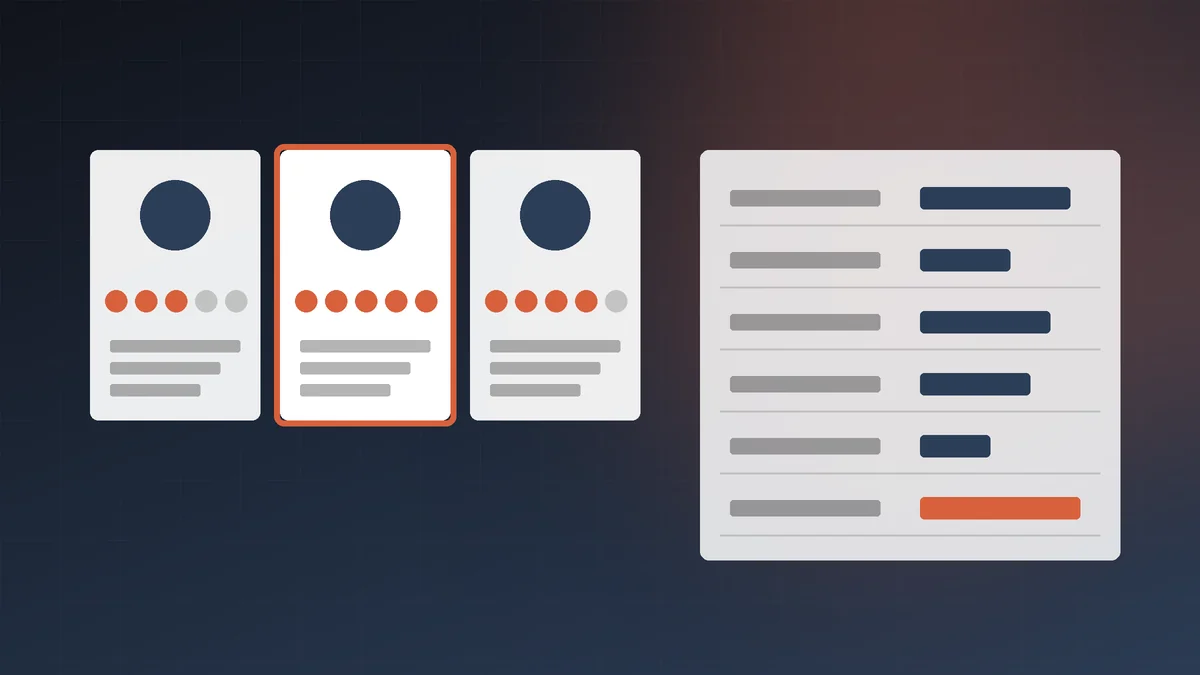

Most sourcing problems start long before a late shipment. They start with an unclear request for quotation, quotes that can’t be compared, and a choice made on unit price alone. A clear RFQ and a weighted supplier scorecard fix most of that, and neither requires expensive software.
This is the process I recommend to small and mid-size manufacturers. The example scores are hypothetical.
Step 1: Define what you’re buying
Before any supplier sees the request, agree internally on:
- Drawing number and revision, material, finish and critical characteristics.
- Annual volume, release quantities and the delivery schedule.
- Quality requirements, such as first article inspection, certificates of conformance and material certifications. In aerospace, first article inspection commonly follows SAE AS9102.
- Packaging, labeling and the Incoterms rule you want quoted (ICC Incoterms rules).
- Any flow-down requirements, such as export controls or cybersecurity clauses. For defense work, see my CMMC basics for small manufacturers.
Step 2: Prequalify suppliers
Invite only suppliers who can actually do the work. A short survey should cover capabilities, equipment, certifications such as ISO 9001 (ISO 9001:2026 replaced the 2015 edition in September 2026, so ask suppliers certified to the 2015 edition about their transition plans), capacity, financial stability, location and country of origin for key inputs. For U.S. sources, regional NIST MEP centers can help connect manufacturers with domestic suppliers.
Step 3: Send a standard RFQ package
Use the same package and the same response form for every supplier. That is the single biggest improvement most companies can make.
RFQ checklist
- Cover letter with the due date, your contact role and how to submit questions.
- Drawings, specifications and the quality requirements from Step 1.
- Volumes, delivery schedule and target start date.
- A quote form with fixed fields: unit price at each volume break, tooling, lead time, minimum order quantity, Incoterms rule, payment terms, quote validity and country of origin.
- Questions about capacity, subcontracted operations and lead times for raw material.
- Confidentiality terms, and a signed NDA if drawings are sensitive.
- A note that all questions and answers will be shared with every bidder.
Step 4: Normalize the quotes to landed cost
Quotes arrive on different terms. Convert each one to a landed cost per unit, including freight, duties, any tariffs, fees and carrying cost for the lead time. My guide to calculating landed cost with tariffs walks through a full example. Without this step, a supplier quoting FOB overseas will always look cheaper than a supplier quoting delivered.
Step 5: Build a weighted supplier scorecard
Pick five or six criteria, give each a weight that totals 100%, and score each supplier from 1 to 5 against a written definition.
Supplier scorecard template
| Criterion | Weight | What a 5 looks like | What a 1 looks like |
|---|---|---|---|
| Total landed cost | 30% | Lowest landed cost per unit | More than 15% above the lowest |
| Quality capability | 25% | Certified system, strong first article and sample results | No quality system, failed samples |
| Delivery and lead time | 20% | Meets required lead time with proven on-time history | Cannot meet required lead time |
| Supply risk | 15% | Low tariff exposure, stable finances, backup capacity | Single site, high exposure, weak finances |
| Responsiveness | 10% | Fast, complete answers during the RFQ | Slow or incomplete answers |
Adjust the weights to your situation. A defense part with strict quality requirements might weight quality higher. A commodity part might weight cost higher.
Hypothetical scoring example
| Criterion (weight) | Supplier A | Supplier B | Supplier C |
|---|---|---|---|
| Total landed cost (30%) | 5 | 4 | 3 |
| Quality capability (25%) | 2 | 4 | 5 |
| Delivery and lead time (20%) | 2 | 4 | 4 |
| Supply risk (15%) | 2 | 4 | 4 |
| Responsiveness (10%) | 3 | 5 | 3 |
| Weighted score | 3.00 | 4.10 | 3.85 |
Supplier A had the lowest landed cost but the weakest quality and delivery scores. Supplier B wins on balance. This is the kind of decision that a unit-price comparison gets wrong.
Calculate each weighted score as the sum of (weight × score). For Supplier B: 0.30×4 + 0.25×4 + 0.20×4 + 0.15×4 + 0.10×5 = 4.10.
Step 6: Validate before you award
- Visit the plant, in person or by video, for critical parts.
- Run a first article inspection or sample lot.
- Check references from customers in your industry.
- Confirm capacity in writing for your volumes.
- For important parts, consider qualifying a second source, even at a small share of volume.
Step 7: Keep scoring after the award
A scorecard used once is a selection tool. Used monthly, it becomes a management tool. Track a few KPIs for each active supplier:
| KPI | How to calculate it |
|---|---|
| On-time delivery | Lines received on or before the due date ÷ total lines received |
| Quality acceptance rate | Units accepted ÷ units received |
| Lead time | Average days from purchase order to receipt |
| Responsiveness | Average days to answer a corrective action or quote request |
| Cost change | Change in landed cost per unit vs. last period |
Share results with suppliers every quarter. Good suppliers want to know where they stand. My Supply Chain Knowledge Base has more KPI definitions, and the tariff exposure and supplier risk checklist helps you score supply risk.
Common RFQ and supplier scorecard mistakes
- Changing the specification mid-RFQ. If a drawing changes, send the new revision to every bidder and reset the due date.
- Scoring after you’ve picked a favorite. Agree on the weights and the 1-to-5 definitions before any quotes arrive, and have two people score independently.
- Comparing quotes with different volumes or terms. Ask every supplier to quote the same volume breaks and the same Incoterms rule.
- Ignoring raw material lead times. A supplier’s quoted lead time often assumes material is in stock. Ask.
- Using the scorecard only to punish. When a score drops, open a corrective action, agree on a root cause and a due date, and recognize the supplier when the score recovers.
When a supplier scorecard shows a problem
Set a threshold, such as on-time delivery below 90% for two months in a row (a hypothetical example), that triggers a formal review. In the review, agree on the root cause, the fix, the date and how you’ll verify it. If the score doesn’t improve, the scorecard already tells you which qualified alternative to call.
How I can help
I build sourcing workflows and supplier scorecards, and supply chain software in Python and SQL that pulls these KPIs from your ERP or spreadsheets. See my manufacturing procurement and supply chain services and AI integration services. For the policy picture behind domestic sourcing, read Restoring U.S. Manufacturing.
Frequently asked questions
What is the difference between an RFQ, RFP and RFI?
An RFI (request for information) gathers general capability information. An RFQ (request for quotation) asks for prices on a clearly defined part or service. An RFP (request for proposal) asks suppliers to propose a solution when the approach itself is open.
How many suppliers should I invite to an RFQ?
For most manufactured parts, three to five qualified suppliers gives you enough competition without overwhelming your team. Prequalify them first so every quote is usable.
Should price be the biggest weight in a supplier scorecard?
Not usually. Use total landed cost rather than unit price, and weigh it against quality, delivery and risk. A cheap supplier that misses dates or fails inspection costs more in the end.
How often should I update supplier scorecards?
Score active suppliers monthly or quarterly on on-time delivery and quality, and review the full scorecard at least once a year or after any major issue.
Additional sources
- ISO: ISO 9001 Quality management systems
- ISO 9001:2015 record (withdrawn September 2026 and replaced by ISO 9001:2026)
- SAE AS9102: Aerospace First Article Inspection Requirement
- International Chamber of Commerce: Incoterms rules
- NIST Manufacturing Extension Partnership
Peter Klausz is an MBA (University of Rochester, Simon Business School) and the founder of Statadventure, LLC, which has built supply chain software in Python and SQL since 2018. He previously managed F100 engine supply chain work at Pratt & Whitney. Based in Burlington, Massachusetts, he is open to contracting and new roles. Book a free 30-minute call.